|
 The
North American Basque Organizations (NABO) officially incorporated
under Nevada State laws on April 19, 1974, with the intentions of
preserving Basque culture and improving communications between Basques
in various communities in the United States. Elected and appointed
delegates from Basque communities began their work of creating networks
of communication and assistance between Basque clubs. Founding clubs
included San Francisco Basque Club, Ely Basque Club of Nevada, Kern
County Basque Club of Bakersfield, California, Emmett Basque Club
of Idaho, Basque Girls' Club of Ontario, Oregon, and the Euzkaldunak,
Inc. of Boise, Idaho. Since those early days the bonds between Basques
in the United States have been strengthened and extended with the
creation of various projects. The annual music camp, sponsored by
NABO, has contributed much to this growth and has provided an arena
for Basque youth in the United States to meet each other and compare
their Basque communities. The
North American Basque Organizations (NABO) officially incorporated
under Nevada State laws on April 19, 1974, with the intentions of
preserving Basque culture and improving communications between Basques
in various communities in the United States. Elected and appointed
delegates from Basque communities began their work of creating networks
of communication and assistance between Basque clubs. Founding clubs
included San Francisco Basque Club, Ely Basque Club of Nevada, Kern
County Basque Club of Bakersfield, California, Emmett Basque Club
of Idaho, Basque Girls' Club of Ontario, Oregon, and the Euzkaldunak,
Inc. of Boise, Idaho. Since those early days the bonds between Basques
in the United States have been strengthened and extended with the
creation of various projects. The annual music camp, sponsored by
NABO, has contributed much to this growth and has provided an arena
for Basque youth in the United States to meet each other and compare
their Basque communities.
 |
The first music camp, organized and funded by the Idaho Basque Studies
Center, was held in Boise, Idaho at the Bogus Basin Ski Resort lodge
in the summer of 1975. Instructors included Jimmy Jausoro and Harley
Rott on the accordion, and Angel Viña, of New York, on the
txistu. Leaders Isabel Larrondo Jausoro and Anes Jayo Mendiola also
taught Basque language, cooking, singing, and culture classes. Oinkari
Basque Dancers from Boise taught Basque folk dance. The first music
camp had thirty participants. Since then, hundreds of young Basques
have gathered for two weeks each summer in a different city of the
extended Basque community in the United States. Under the direction
of local and visiting talent from Europe, participants study Basque
folk dance, music (either txistu or accordion), singing, games (such
as the card game mus) and sports such as pelota and pala.
 | |
Besides being a good learning experience, the camp offers the participants
a great opportunity to develop ties and friendships with other young
Basques from many states whose parents and ancestors came from both
the northern and southern parts of Euskal Herria. The relationships
formed over the two-week period increase the present and future
interaction between all of the Basque clubs, as those children often
grow up to be the leaders of their own institutions. Music Camp,
now called Udaleku, is a unique experience for both the participants
who meet other Basques from other communities, and for the teachers
granted the opportunity to teach younger generations of Basque-Americans
about their culture. The camp is meant to impart to young Basque-Americans
an appreciation for the uniqueness of their heritage.
The Udaleku objectives and organization include the following:
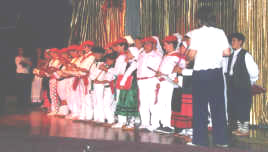 |
| Udaleku Txistu Band |
- MUSIC. Every student must make an attempt at learning, or improving,
on either the accordion or txistu.
- DANCE. Every student will be expected to participate in dance
rehearsals and make an attempt to learn as many of the dances as
possible.
- SINGING. Participants will take part in singing sessions in which
both old and new Basque songs from all seven provinces will be learned.
- LANGUAGE. This being a Basque music camp, "Euskara"
or the Basque language should be present and apparent. No one can
learn the language in two weeks, but an effort should be made to
introduce the language.
- GROUPS. All the participants will be divided up into seven groups,
one for each of the seven Basque provinces. The function of these
groups is to better organize the camp and coordinate instruction.
The groups, each coordinated by a music/dance instructor, would
aim to accomplish teaching the following: Mus & pala instruction;
Euskara; cooking, tambourine, and their group/province presentation.
List of previous Music Camp hosts since 1985:
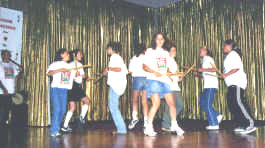 |
| Udaleku Lapurdiko Makila |
- 1985: Hosted by the Boise Oinkari Dancers
- 1986: Hosted by the Elko Basque Club
- 1987: Hosted by the Los Banos Basque Club
- 1988: Hosted by the Boise Basque Club
- 1989: Hosted by the Bakersfield Basque Club
- 1990: Hosted by the Elko Basque Club
- 1991: Hosted by San Francisco area clubs
- 1992: Hosted by the Boise Basque Club
- 1993: Hosted by the Chino & Southern California Clubs
- 1994: Hosted by the Reno Basque Club
- 1995: Hosted by San Francisco area clubs
- 1996: Hosted by the Boise Basque Club
- 1997: Hosted by the Kern County Basque Club
- 1998: Hosted by the Elko Basque Club
- 1999: Hosted by the S.F. Basque Cultural Center
- 2000: Hosted by the Buffalo Big Horn Basque Club
- 2001: Hosted by the Chino Basque Club with So. California &
Ventura
- 2002: Hosted by the Reno Basque Club
 Prior
to the creation of NABO and the music camps, Basques of Bizkaian
descent in communities of Idaho and Nevada interacted little with
the Basques of California, whom were largely northern or "French
Basque." When delegates from the Basque clubs of Los Banos
and San Francisco, California; Boise and Emmett, Idaho; Elko, Ely
and Reno, Nevada; and Ontario, Oregon gathered together, they were
well aware that there was little if any communication between the
various Basque clubs of the American West. They were attempting
to cross the divide- real and imagined- between Basque-Americans,
and their venture has resulted in absolute success. In 2002, eight
individuals, four of whom are from the Basque Country, instructed
the children and teenagers in Euskara, Basque culture, txistu, txalaparta,
dance, and Basque cuisine. In addition to the regular class sessions,
participants also enjoyed a variety of field trips including on
to the historic Ponderosa Ranch, the site of the filming of the
long-running television show "Bonanza". Prior
to the creation of NABO and the music camps, Basques of Bizkaian
descent in communities of Idaho and Nevada interacted little with
the Basques of California, whom were largely northern or "French
Basque." When delegates from the Basque clubs of Los Banos
and San Francisco, California; Boise and Emmett, Idaho; Elko, Ely
and Reno, Nevada; and Ontario, Oregon gathered together, they were
well aware that there was little if any communication between the
various Basque clubs of the American West. They were attempting
to cross the divide- real and imagined- between Basque-Americans,
and their venture has resulted in absolute success. In 2002, eight
individuals, four of whom are from the Basque Country, instructed
the children and teenagers in Euskara, Basque culture, txistu, txalaparta,
dance, and Basque cuisine. In addition to the regular class sessions,
participants also enjoyed a variety of field trips including on
to the historic Ponderosa Ranch, the site of the filming of the
long-running television show "Bonanza".
 |
| Elko-98 |
The final performance for the Udaleku allows students to demonstrate
their new skills for their families and the larger community. The
2002 performance at the Reno Hug High School Gymnasium included
a slide show, a short theatre-play in Euskara, dancing, txalaparta,
and singing. The audience of approximately 400 people was extremely
proud of what these young Basques have learned, and expect them
that the traditions and customs of Basque culture will be carried
on for another generation, thanks to this NABO program.
Bibliography of sources
Totoricagüena, Gloria. Comparing the Basque Diaspora.
Reno: University of Nevada Press. 2003.
Totoricagüena, Gloria. Boise Basques: Dreamers and Doers.
Serie URAZANDI. Vitoria-Gasteiz: Eusko Jaurlaritza. Forthcoming
2003.
Gloria Totoricagüena
Egurrola
Center for Basque Studies University of Nevada Reno |